About TAC
I wanted to stop being unprepared for my friends.
TAC is a virtual tabletop that generates maps, monsters, audio, and notes from your descriptions. This is the story of why I built it.
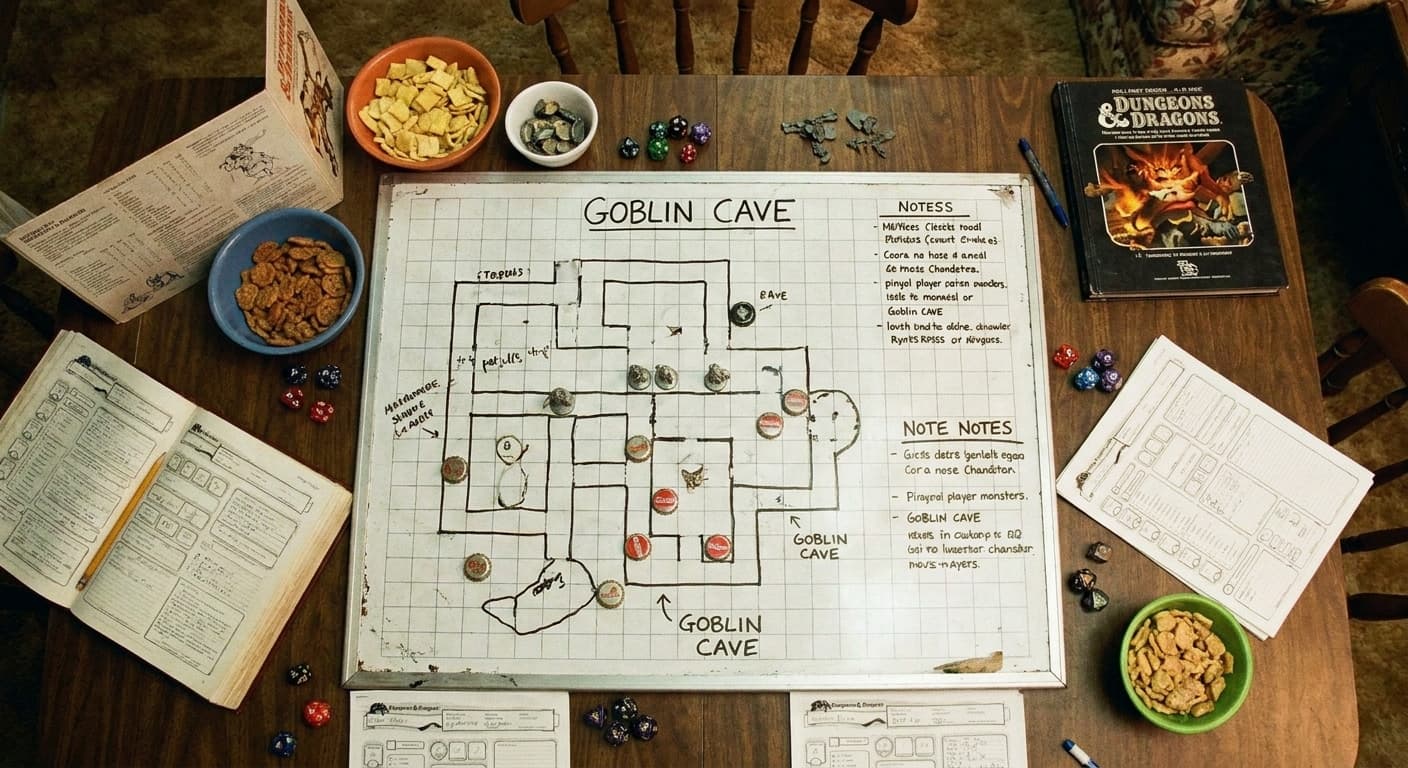
Bottle caps on a whiteboard.
For years, our table ran in person. A dry erase battlemap on my kitchen island, bottle caps for the goblins, a few HeroForge minis for the PCs, and whatever spare tokens we could yoink from a D&D board game when the encounter outgrew our supply of caps.
It worked because we were in the same room. Prep was a notebook and a pencil. Improvisation cost nothing. If the party walked through a door I hadn't planned for, I drew a new room in front of them while someone topped off the chip bowl.
Then life happened.
Friends moved cities. COVID closed the kitchen. The Saturday that used to be sacred got harder to defend. The third week in a row someone texted to cancel was the week I knew we needed to move online or stop playing.
So we moved online. That's when the real prep wall started.
The Roll20 years.
Roll20 worked, eventually. But getting there meant buying every book and adventure again from Roll20's marketplace, rebuilding character sheets by hand, and learning macros just to keep combat from grinding to a halt. The tedium was real for me as the DM, and just as real for the players. We spent more time fighting the tools than we spent playing.
FoundryVTT. Closer, but not it.
Eventually we stumbled into FoundryVTT, and with the right community modules we could finally import characters and adventures from D&D Beyond. That cut setup by hours, once we'd bought our books over again on D&D Beyond so the importers had something to pull from. It felt like the future.
And then it didn't. Premium content for Foundry often meant paying publishers a second time on top of D&D Beyond. Players hopped between platforms to maintain their sheets and to actually play. Worst of all, the moment I wanted to run something custom (homebrew monsters, a map of a place that doesn't exist in any published book, an NPC nobody has art for), the wall came right back. Powerful tool, expensive setup, low flexibility for the one thing I actually cared about: my table, my world, my friends.
Where the idea came from.
I'm a software engineer by trade, and I've been working with AI hands on since early 2021. By 2023 it was obvious to me that the gap between “cool idea on Tuesday” and “play it on Saturday” was a tooling problem, not a creativity problem. DMs don't lack vision. They lack time, art they're allowed to use, audio that fits the scene, and a single place to put it all. They shouldn't have to keep rebuying the same books on every new platform just to start playing. Creativity should be the constraint, not the budget.
So I started prototyping. Maps. Monsters. Audio. Notes. All of it generated, all in one place, all bootstrapping the DM's vision. Three years of iteration later, my friends and I playtest weekly. A new session takes under fifteen minutes to set up. A player can roll a new character from scratch in under ten.
Two hours of prep ends with “maybe next week.” Fifteen minutes ends with “see you Saturday.”
The AI choice.
TAC uses AI to generate art, audio, and stat blocks. The realistic alternative for a working DM isn't commissioned art. A single map runs $40 to $200 and takes weeks. What most DMs actually reach for is scraped Pinterest or no art at all. None of those were honest answers either.
I tried most of the options. Stable Diffusion was inconsistent across scenes. GPT Image's guardrails fought the genre. Midjourney's API and licensing made it impractical at session-prep speed. TAC currently runs on Gemini (“Nano Banana”) because it's fast enough for the loop, cheap enough to give DMs real volume, and doesn't flinch at the genre. When something better ships, TAC will move to it.
What I'm actually building.
TAC is a tool for the version of me running games in a dorm room in 2009, then in living rooms a few years later, drawing corridors in front of his friends because they walked through doors he didn't plan for. That table has scattered across new cities and new jobs since then. TAC is how we keep meeting.
I built this so I'd stop being the reason Saturday didn't happen.
Matt
Start your next session in fifteen minutes.
Players join free. See DM pricing →